The PhiNutriomics Approach
How the body responds to its environment
When nourishment, environment, and individuality align, the body returns to its natural rhythm of regulation.
Health as Communication
The body is a living system, constantly sensing and responding to information.
It maintains balance through communication — not through correction.
Signals arrive continuously — through food, light, air, movement, and experience.
When these signals are clear, the body functions with coherence and precision.
When they become overwhelming or distorted, it adapts as best it can.
This process is shaped by three elements — the signals the body receives, the individuality of the person, and the body’s capacity for balance.
The PhiNutriomics Lens
The name PhiNutriomics reflects three elements that shape how health is expressed.
φ (Phi) — Dynamic Balance
Health is not fixed — it is continuously adjusting — a living balance that shifts with time, environment, and life stage.
Nutri — Information from the Environment
Everything the body receives acts as information — food, light, air, movement, and the spaces we inhabit.
Omics — Biological Individuality
Each person responds differently. Health is shaped by genetics, history, and environment.
Together, these form a lens through which health can be understood — as a dynamic interaction between environment, individuality, and biological regulation.
When Stress Becomes Noise
Stress is the body’s adaptive response to perceived demand — a process that allows it to mobilise energy, maintain balance, and respond to change.
When this response is well-timed and resolves appropriately, it supports resilience and repair.
When it becomes prolonged or excessive, it can disrupt communication between systems.
This process is coordinated through interconnected networks — including the nervous, endocrine, and immune systems — and influences energy, inflammation, and the body’s capacity to adapt.
From this perspective, stress becomes problematic when signalling loses clarity or resolution — contributing to what can be understood as noise within the system
How the Body Regulates
Biological regulation follows a simple cycle:
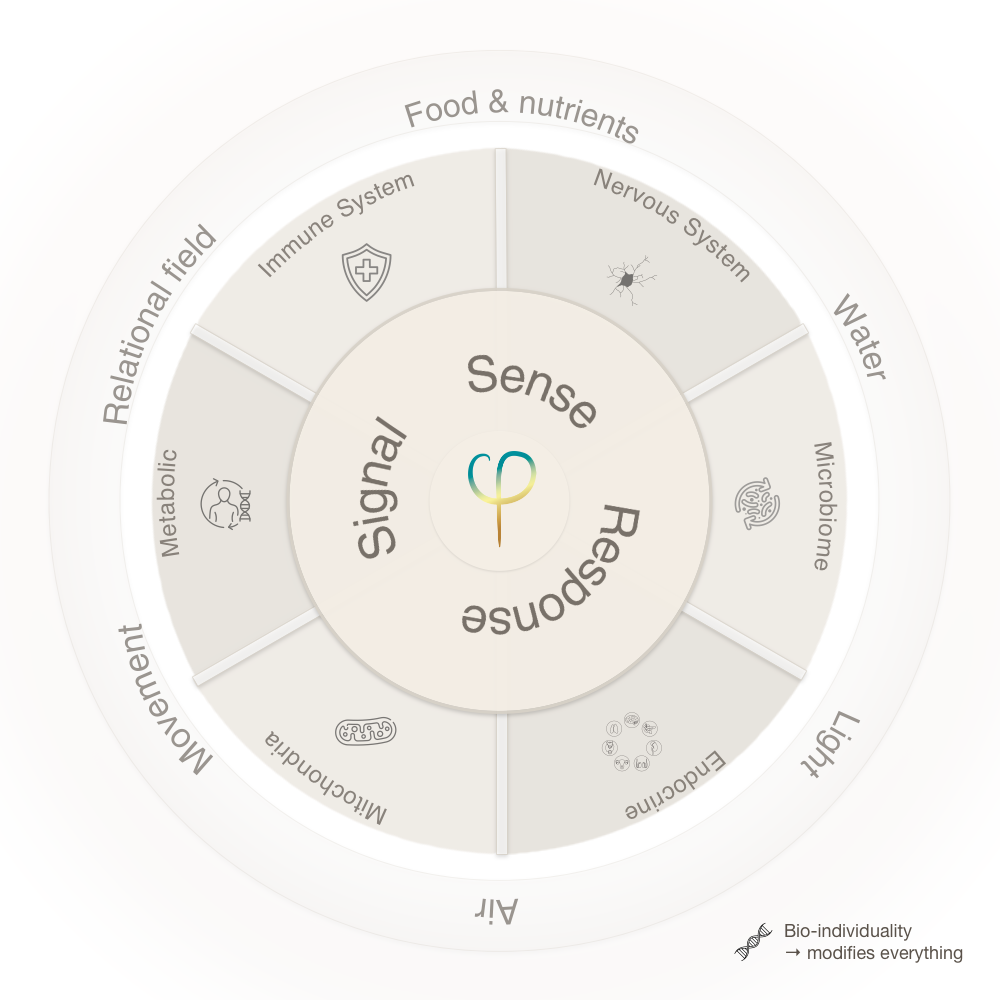
Signal → Sense → Respond
Signals arise from both the environment and internal physiology.
The body senses these signals through its communication systems.
It then responds through metabolic, hormonal, immune, and behavioural changes.
When this cycle is clear, the body remains adaptable and resilient.
When it becomes disrupted, regulation becomes more difficult.
When Signals Become Noisy
Modern environments introduce forms of interference that can affect how the body communicates.
This may include environmental exposures, disrupted rhythms, chronic stress, or cumulative strain.
Over time, this can make it harder for the body to interpret signals clearly and respond effectively.
From Interference to Clarity
Supporting the body begins with reducing interference.
Rather than overriding its responses, the focus becomes creating the conditions in which it can function more effectively.
Small, well-placed shifts can restore clarity — allowing the body to respond, rather than compensate.
Restoring the Conditions for Regulation
This work unfolds across five key domains:
Nervous system regulation
Supporting a state of safety so signals can be interpreted clearly
Metabolic support
Enhancing energy production and adaptive capacity
Reduction of environmental exposures
Reducing inputs that disrupt biological communication
Circadian rhythm restoration
Re-aligning the body with natural cycles
Emotional and relational safety
Creating conditions in which regulation can be sustained
Together, these shifts reduce background noise and allow biological coherence to re-emerge.
How This Becomes Practical
This approach takes form through different spaces:
Courses
Workshops
Retreats
Nervous system regulation sessions
Each offers a different entry point into the same underlying work.
Widening the Lens
Health does not exist in isolation.
The body lives within layers of environment — from cells, to home, to the wider living world.
When these relationships are supportive, the body is able to sense, respond, and function with greater ease.
When they are strained, it adapts as best it can.
PhiNutriomics is grounded in restoring these relationships — gently, practically, and with respect for the intelligence of living systems.
The aim is not to impose health.
It is to restore the conditions in which the body can sense clearly,
respond appropriately,
and return to its natural rhythm.